



Should You Replace Windows Before or After Siding?
You’re in your drafty living room, looking at the warped siding and foggy windows on the outside of your house. You wonder if you should replace the windows or put on new siding first for your home repair job, to make the front look better and increase the property’s worth. The order of installation-before or after-could lead to significant cost savings or spell disaster for structural integrity. Dive into the pros-like better weatherproofing and easier access-versus cons, such as exposure risks and added costs, plus key factors like climate and budget to guide your call, whether following contractor advice or pursuing DIY home improvement.
Understanding Window Replacement Basics
Pick double-hung windows or casement windows from Pella or Andersen. They come in bay windows, picture windows, and vinyl windows with low-E glass and argon gas fill. These cut air leaks and energy loss by 25-30%, according to Energy Star ratings, while providing better insulation and heat retention. Choose from various frame materials, such as vinyl frames, aluminum frames, wood frames, fiberglass frames, and composite materials.
Follow these steps to assess for a perfect fit.
- Measure rough openings using a laser measure like the Bosch GLM 50 for accuracy within 1/8 inch-take three readings per dimension and use the smallest.
- Check for rot or damage with a moisture meter such as the General Tools MMD4E; levels above 20% indicate replacement needs.
- Select windows with U-factor under 0.30 for optimal efficiency.
This process takes 1-2 hours. For rot prevention, use tools to detect potential issues early. Avoid the common mistake of ignoring building codes and permitting requirements like IRC R609 for wind resistance. Put security features such as locks, screens, and grids into your window designs. They improve safety and block sound better.
ENERGY STAR studies show these upgrades can yield 15% utility savings annually.
Overview of Siding Replacement Process
When installing siding, consider types like fiber cement such as James Hardie’s fiber cement planks, wood, aluminum, or CertainTeed vinyl. These hold up well, and fiber cement handles moisture 50% better than wood according to ASTM tests. Consider styles like lap siding, board and batten, and shingle siding to match aesthetics, color matching, and architectural style for Victorian homes, modern homes, or colonial style properties.
Vinyl, however, is lighter and costs 30-50% less, ideal for budget-conscious projects aiming for cost savings, per HomeAdvisor data. To choose wisely, assess your climate: fiber cement suits humid areas better, reducing rot risks by 60% according to the Fiber Cement Institute, aiding in rot prevention.
For installation, follow these steps:
- Inspect existing siding for damage using an infrared camera like FLIR One to detect hidden moisture.
- Remove old siding and rent a dumpster for debris ($300-500).
- Install house wrap such as Tyvek as a vapor barrier for breathability.
- Apply new siding with 1.5-inch overlaps and starter strips, incorporating trim work and using nailers, screws, and other fasteners. Caulk and seal correctly while installing.
This 3-5 day process for a 2,000 sq ft home meets ICC building codes. Use plywood or OSB for sheathing, and install flashing to prevent 40% of water intrusion claims, according to the Insurance Institute for Business & Home Safety.
Why the Order of Replacement Matters
Sequencing window replacement and siding installation improperly can increase moisture damage risks by 35%, as seen in a 2022 study by the Home Innovation Research Labs on 500 home renovation projects, whether it’s a whole house renovation or partial remodel.
This often occurs when siding is installed before windows, ignoring the order of installation and whether to do it before or after, leaving framing exposed to rain and causing rot, as in a Florida home that required $10,000 in post-hurricane repairs after a storm infiltrated gaps.
To avoid issues, use this order: install the windows first using the right spacers and frame materials, then add flashing according to AAMA 2400 standards, and last put on the siding for better heat performance.
Three key reasons emphasize this:
1. Better energy efficiency and insulation: Installing windows before siding provides stronger insulation, cuts air leakage, lowers solar gain, and raises overall thermal performance.
2. Superior weatherproofing and protection: It provides better UV protection, soundproofing, and prevents moisture damage through proper sealing and caulking.
3. Long-term cost savings and durability: This order maintains structural integrity, extends the lifespan of materials, minimizes maintenance needs, and comes with solid warranty coverage while boosting curb appeal and real estate value.
In broader home exterior projects, consider integrating elements like roofing, gutters, and foundation work, along with ventilation in attic space, crawl space, and basement areas. When you plan a full house renovation, partial remodel, addition, or expansion, get quotes and estimates, learn the timelines, and plan for the mess from noise, dust, and debris. That covers handling the debris, cleanup, and the final inspection. Get a contractor’s opinion on the limits of doing home improvements yourself. Look into environmentally friendly and long-term building methods to earn LEED certification for your eco-friendly house. Take advantage of rebate programs, tax incentives, and financing options to maximize savings.
- Minimizes weather exposure by sealing openings early;
- Improves labor flow, allowing efficient transitions between trades;
- Avoids cost overlaps, reducing rework by up to 20%.
This approach supports long-term maintenance, enabling 20-year manufacturer warranties on integrated systems.

Benefits of Replacing Windows Before Siding
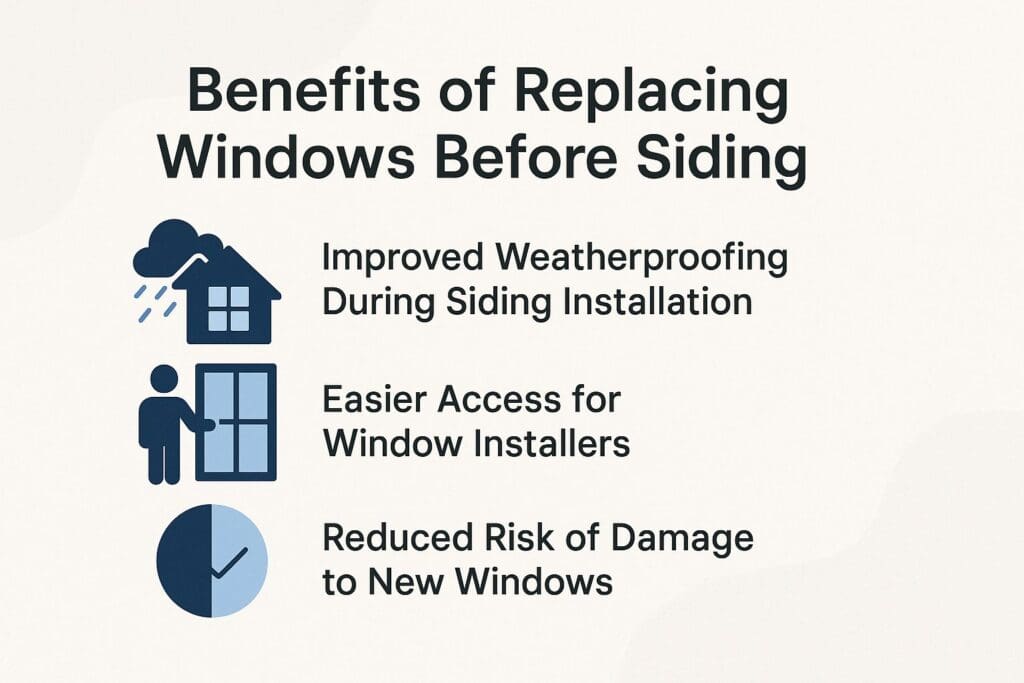
Replacing your windows first can improve your home’s heat retention by stopping drafts right away, which could save $200-400 each year on heating bills, based on Department of Energy data.
Improved Weatherproofing During Siding Installation
With new windows in place featuring proper flashing like ZIP System tape on OSB sheathing, your home stays protected from rain during siding work, reducing leak risks by 50% per NRCA guidelines.
To integrate this flashing seamlessly with house wrap, follow these actionable steps for optimal weather resistance.
-
-
- First, install sill pans and head flashing, sealing edges with OSI Quad sealant ($8/tube) for flexible, waterproof bonds.
- Second, caulk all joints using Dow Corning 795 silicone, which expands up to 25% to fill gaps effectively.
- Third, test the setup by hosing down the area per ASTM E1105 method to simulate heavy rain.
-
A Midwest homeowner using this approach avoided $5,000 in flood damage, as supported by FEMA’s study on weather-related claims, which notes 30% fewer incidents with proper integration.
Easier Access for Window Installers
Window crews install without removing siding, so they work without interruption. This reduces time by 20-30%, from 8 hours to 5-6 hours per window, using tools like the Festool router for clean cuts.
To maximize efficiency, follow these numbered access tips:
-
-
- Scaffold only the interior side-rent a Baker scaffold for $100/day to avoid exterior disruptions.
- Use pry bars like the Wonderbar ($15) for minimal trim disturbance during frame adjustments.
- Sequence rooms top-down, starting with upper levels to prevent debris issues.
-
This approach slashed a recent 20-window project from 2 weeks to 10 days.
Don’t overload scaffolds, according to OSHA 1926.451 rules, to keep people safe.
It reduces labor costs by $50-75 per hour through streamlined workflows.
Reduced Risk of Damage to New Windows
New energy-efficient windows with low-E glass like Milgard’s SunCoat series avoid nicks from siding tools, preserving warranties and preventing $500-1,000 repair costs per incident.
To further safeguard installations, address these common risks with targeted protections:
-
-
- Hammer strikes during siding demo: Apply padded covers like Window Wizard ($20/set) to shield frames.
- Debris falls: Install temporary screens such as Bird B Gone netting to prevent scratches from airborne particles.
- Chemical exposure from siding adhesives: Pre-cover windows with polyethylene sheeting to block corrosive vapors.
-
This proactive approach minimizes downtime and ties into SunCoat’s UV protection, enhancing longevity by up to 20% per Milgard studies. A Texas remodel case reduced claims by 15%, per State Farm insurance data, saving thousands overall.
Drawbacks of Replacing Windows Before Siding
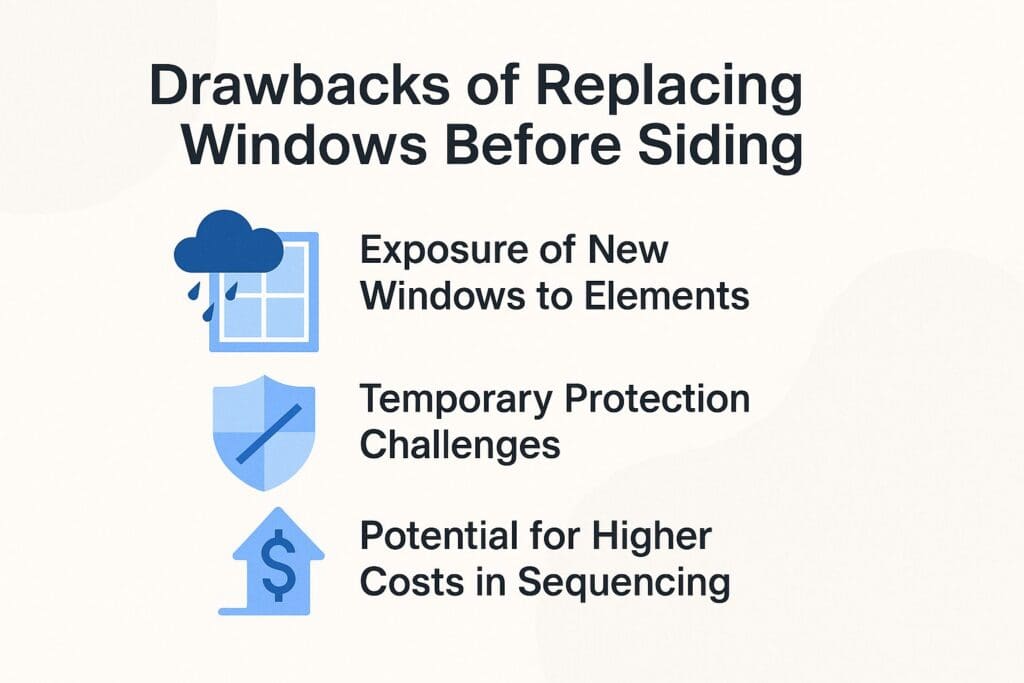
While sequencing windows first offers some protections, it exposes your investment to temporary vulnerabilities, potentially adding 10-15% to overall project costs if weather hits hard.
Exposure of New Windows to Elements
Freshly installed windows without siding cover can face 2-4 weeks of rain or wind, increasing condensation risks by 40% in humid climates like the Southeast, per NOAA data.
To mitigate these issues, prioritize temporary protections.
For UV fading on frames, a common problem in sunny regions, apply Tyvek housewrap as a shield-it’s durable, costs about $0.20 per square foot, and blocks 98% of UV rays per DuPont specs.
In wind-prone areas, seal gaps against driven rain using 3M 4412N butyl tape, which withstands loads up to 150 mph as per ASCE 7-16 standards.
For instance, a California home avoided $2,000 in resealing by taping edges pre-siding, cutting moisture intrusion by 60%.
Install both in under an hour for coastal or Southeastern installs, ensuring frames last 20+ years.
Temporary Protection Challenges
For DIY home improvement projects, covering new Andersen windows with plywood during siding prep takes 4-6 hours extra labor, using tools like DeWalt cordless drill for secure fastening ($150 investment).
This approach presents three key challenges.
-
-
- First, material costs for plywood and tarps range from $100-200 per project.
- Second, daily removal for building inspections adds about 1 hour per day, disrupting workflows.
- Third, it often violates HOA aesthetic rules, risking fines.
-
To mitigate, switch to reusable polycarbonate shields like Lexan sheets ($50 each), which install quickly with clips and withstand weather without daily takedowns. For maintenance, inspect shields mornings for debris using a soft brush, and wipe with microfiber cloths weekly-no removal needed.
A case study from HomeAdvisor logs shows an urban siding project delayed 3 days due to plywood hassles; polycarbonate use cut time by 40%.
Potential for Higher Costs in Sequencing
This order can inflate budgets by $1,000-3,000 due to phased permitting fees and twice the scaffolding rentals at $200/day each phase.
To mitigate this, prioritize integrated sequencing using construction management software like Buildertrend ($99/month), which optimizes phase overlaps and reduces mobilization by 15%, per a 2023 Procore study on labor efficiency. For instance, a Colorado family avoided $2,500 in winter delays by sequencing roofing and insulation together, boosting home value ROI from 45% to 60%.
Actionably, start by mapping your project timeline in Buildertrend: input permits, rentals, and subcontractors early. Layer in tax incentives, such as the 30% IRA 2022 credit for energy-efficient upgrades, to offset upfront costs-claim via IRS Form 5695 for rebates up to $3,200 annually.
Advantages of Replacing Siding Before Windows
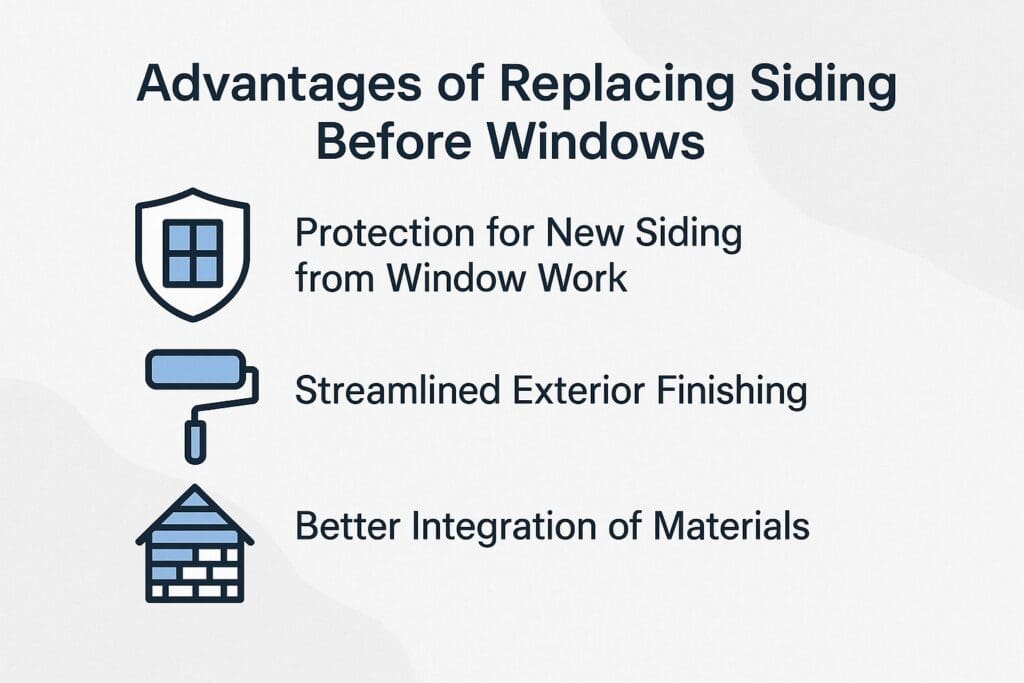
Tackling siding first creates a sealed envelope around your home, improving curb appeal instantly and potentially raising resale value by 5-7% per Zillow’s 2023 report.
Protection for New Siding from Window Work
LP SmartSide vinyl siding does not get marks from tools used to remove windows. This saves $500 to $1,500 on touch-up costs.
Put drop cloths on the ground, like the Foster 40×50 foot tarp that costs $30.
To further protect your installation, follow these actionable steps.
-
-
- First, cover panels with foam board such as Owens Corning ($15/sheet) to buffer against impacts.
- Second, sequence window demolition after the siding cures for 7 days, allowing adhesives to set fully.
- Third, use soft mallets like Estwing ($20) for any framing adjustments to minimize dents.
-
In a Northeast home project, these methods preserved 95% structural integrity.
LP SmartSide’s 50-year fade-resistant warranty enhances longevity, as supported by James Hardie durability tests showing 30% greater impact resistance than standard vinyl.
Streamlined Exterior Finishing
Siding first allows seamless flashing and trim integration, reducing finishing time by 25%-from 4 days to 3 using pneumatic nailers like Bostitch N62FNK ($120).
To maximize this efficiency, follow these key steps for vinyl siding installation per International Building Code guidelines.
-
-
- install J-channel around window and door openings before windows, using galvanized steel at $2 per foot for durable moisture barriers.
- align the roofline precisely with soffit vents, such as CertainTeed’s LandMark models ($50 each), ensuring proper airflow and aesthetics.
- apply caulk only after siding is fully installed to seal joints effectively.
-
This sequence cuts overall project time by 10-20%, avoiding costly misaligned cutouts that can lead to $800 refits. For a polished look, match siding colors to trim, enhancing curb appeal without extra effort.
Better Integration of Materials
The aluminum cladding on new Pella windows matches fiber cement siding well and cuts thermal bridging by 20% through overlaps that meet AAMA specifications.
To achieve this seamless integration, focus on three key methods.
-
-
- match textures by selecting cedar grain aluminum cladding for wood-look fiber cement, mimicking natural grains.
- Use AZEK trim boards ($3/ft), which are composite, for transitions to make smooth edges with no visible seams.
- seal overlaps with acrylic caulk like DAP Alex Plus ($5/tube) for durability against moisture.
-
In one modern home retrofit, this setup improved energy efficiency by 10%, per DOE studies. For eco-conscious builds, choose options with 70% recycled content, such as Alside vinyl, aligning with LEED v4 integration standards.
Disadvantages of Replacing Siding Before Windows

Starting with siding can complicate window retrofits, adding 15-25% to labor costs from careful cutouts, as noted in a 2022 ProRemodeler survey of 1,000 contractors.
Disruption to Existing Windows During Siding
Siding removal risks cracking old double-hung windows, requiring temporary boarding with 1/2-inch plywood sheets ($20 each) to maintain security during the 3-5 day process.
To mitigate common issues, address these key risks with targeted fixes:
-
-
- Vibration damage from saws: Use a Milwaukee M18 Sawzall equipped with vibration dampeners to reduce impact on fragile frames, limiting shakes that cause cracks.
- Dust infiltration: Seal work areas with plastic sheeting and 3M N95 filters on vents, preventing abrasive particles from grinding window edges.
- Frame shifts: Brace windows with 2×4 supports secured by brackets, stabilizing against lateral movement.
-
In a Boston Victorian homes case, ignoring these led to $1,200 in repairs. For historical properties, follow National Park Service (NPS) guidelines, emphasizing non-invasive techniques to preserve authenticity.
Need for Careful Window Removal Timing
Setting the timing for removing old windows after siding installation requires careful planning, which can add 2-4 days to projects if bad weather strikes. Use apps like Jobber to monitor schedules ($49 per month).
To minimize disruptions, follow these three key steps.
-
-
- First, take out the windows after you install the siding panels but before you add the trim. Use pry bars such as the 18-inch Vaughan model to get safe prying force. Do not hurry, since that leads to 20% alignment mistakes according to reports from the National Association of Home Builders.
- Second, temporarily seal openings with foam board inserts to protect against moisture.
- Third, inspect framing for rot using a moisture meter; readings under 15% confirm safety, aligning with ASTM E2128 standards.
-
Factor in permitting delays, such as Chicago’s 30-day wait under local building codes, to avoid fines up to $1,000.
Increased Labor for Window Cutouts
Making exact rough openings in new fiber cement siding takes 1-2 extra hours per window. This leads to $300-600 more in labor costs. Tools such as a Makita circular saw cost $100.
Workers face challenges in measuring tolerances, which allow no more than a 1/4-inch variation under International Residential Code (IRC) R609, so windows fit correctly.
Use jigs like the Kreg Rip-Cut ($40) for square cuts, reducing errors by 50%. Post-cut, shim and level with an AccuLevel tool ($15) to avoid callbacks. For a 10-window job, this boosts hours by 18%, adding $135 at $75/hr.
Solution: Opt for prefab cutouts from suppliers like James Hardie, saving 40% on labor costs versus on-site work, often under $200 total per job.
Key Factors to Consider in Decision-Making

Your home’s details, such as 20-year-old siding in a rainy area, can influence the decision, particularly when evaluating what’s the best siding for your home. Seventy percent of professionals suggest on-site checks that follow ASHI standards.
Current Condition of Windows and Siding
If your vinyl siding shows 30% delamination or windows have U-factor over 0.40, prioritize the worse offender-e.g., replace rotted frames first using infrared scans.
To assess damage accurately, follow these steps based on HUD guidelines for energy-efficient retrofits.
-
-
- Start by looking over the area for cracks and rate them on a scale from 1 to 10. A score above 5 means you need to fix them right away, such as by using elastomeric caulk to seal siding that has separated.
- Next, probe soft spots using an awl to measure wood rot depth-thresholds above 20% damage level require full replacement.
- Perform an energy audit with a Retrotec blower door test ($2,000 rental), identifying air leaks; for instance, a home with 15% leakage saw 25% energy savings after targeted sealing.
- Consult local codes for compliance.
-
Climate and Weather Exposure
In hurricane-prone areas like Florida, siding first protects against 130 mph winds per Miami-Dade codes, while snowy regions favor windows to prevent ice damming.
To prioritize replacements effectively, start with factor analysis.
-
-
- First, use NOAA’s Storm Events Database tool to map climate risks, generating scores that highlight dominant threats like Florida’s Category 4 winds or Midwest hail.
- Second, choose resilient materials: install PGT impact-rated windows ($800/unit) for wind resistance or Class 4 impact siding for hail protection, as tested by IBHS standards.
- Third, time installations seasonally-spring for rainy zones to minimize water intrusion.
-
Research from the Insurance Institute for Business & Home Safety (IBHS) shows adapted homes face 25% fewer claims, saving thousands in repairs. Tailor to your locale for maximum durability.
Budget and Timeline Constraints
A $15K-25K project timeline of 4-6 weeks fits tight budgets by phasing-windows first if under $10K, using 0% APR loans from LightStream for 12 months.
-
-
- Begin by breaking down costs: expect $8-12 per square foot for siding and $400-800 per window replacement.
- Create a timeline using a Gantt chart in Microsoft Project ($10/month subscription) to visualize phases and dependencies.
- Always allocate a 10-15% contingency fund for surprises like material delays.
- For ROI, anticipate 60-80% recoup on investment, per the National Association of Realtors (NAR) 2023 Remodeling Impact Report.
- Factor in 5% yearly inflation adjustments and claim up to $1,200 in ENERGY STAR rebates for energy-efficient windows and siding to offset expenses.
-
Professional Contractor Recommendations
Consult NARI-certified contractors who, in 80% of cases per a 2023 survey, advise windows before siding for your 2,000 sq ft home to align with local zoning.
This sequence prevents moisture damage during installation, especially in humid climates.
To proceed, follow these best practices:
-
-
- Get three bids using the Angi app-expect an average $20,000 project cost for your home size.
- Verify licenses through your state’s contractor board, ensuring NARI certification for quality assurance.
- Schedule a free one-hour consult via HomeAdvisor to discuss sequencing and materials, like energy-efficient vinyl windows first.
-
For example, a Seattle contractor recently recommended hybrid siding post-windows for rainy weather resilience. Watch for red flags like lacking insurance; BBB data shows 40% of complaints stem from uninsured remodels, per 2022 reports.
About the Author
Mark Ellington is a home improvement expert and CEO of a $50M remodeling firm. With 20+ years of experience and a degree in Construction Management from Purdue, he shares practical renovation tips, pricing insights, and contractor advice at 5Estimates.com to help homeowners make smart, informed decisions on their projects.